
Key Takeaways
- The Next Evolution of AI: Agentic AI represents a shift from passive, content-generating models to proactive, autonomous systems that can independently reason, plan, and execute multi-step tasks to achieve a specific goal.
- Fueled by High-Quality Data: An agentic AI is only as effective as the data it uses for reasoning. A unified, governed Cloud Data Lakehouse is the essential foundation, providing agents with a reliable “source of truth” to ground their decisions and actions.
- Agents Act Through Tools: The power of agentic AI comes from its ability to use external tools like APIs, databases, and other software systems to take action in the real world. This moves AI from being a creator to a “doer.”
- AgentOps is the New MLOps: Deploying autonomous agents requires a specialized MLOps (or “AgentOps”) discipline focused on monitoring agent behavior, ensuring the reliability of tool use, managing complex dependencies, and implementing robust safety guardrails.
- Hybrid Retrieval is Crucial: For an agent to act intelligently, it needs more than simple vector search. A production-grade agentic architecture requires a hybrid retrieval strategy, combining vector, keyword, and graph-based search to understand semantics, facts, and complex relationships.
- Governance Prevents Rogue Agents: Autonomy requires accountability. Cloud-native security and governance, including fine-grained access control (IAM) and bias detection (like Amazon SageMaker Clarify), are critical for ensuring agentic AI operates safely and predictably.
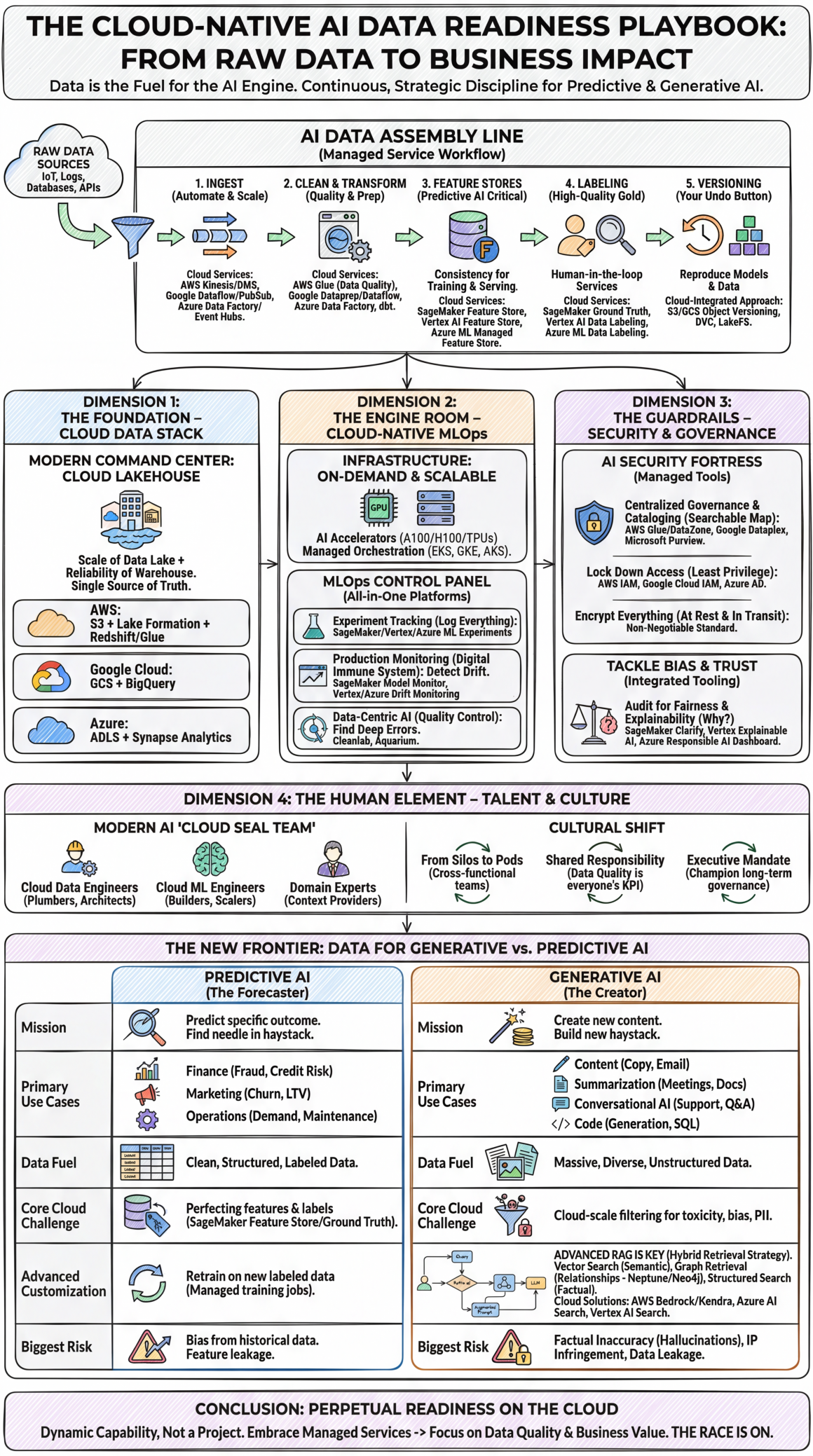


Introduction: From Generative AI to Agentic AI, the Next Frontier
In the world of Artificial Intelligence, we’ve marveled at the engines—the algorithms, complex neural networks, and massive Large Language Models (LLMs) that generate human-like text and images. But a generative AI fed with messy, untrusted information will confidently lie to your customers. “Garbage in, garbage out” has become “catastrophe in, catastrophe out.”
Now, we are entering the next frontier: Agentic AI. This represents a profound shift from passive models that simply respond, to proactive systems that can reason, plan, and act autonomously to achieve goals. An agentic AI system doesn’t just write an email; it can plan a marketing campaign, execute it via APIs, analyze the results, and adapt its strategy based on performance, all with minimal human intervention.
But the most powerful agent is useless without the right fuel and the right engine. Today, the great differentiator in building effective agentic AI is not just the model you use, but the data you feed it and the operational discipline you enforce. Achieving “agent readiness” is not a pre-flight checklist. It’s a continuous, strategic discipline. This is the production-grade, cloud-native playbook for building autonomous systems that create real business impact.
Dimension 1: The Foundation – Your Cloud Data Stack for Agentic AI
An agent’s ability to reason and act effectively is directly tied to the quality and accessibility of its data. Siloed, on-premise systems can’t provide the scale and real-time integration that autonomous agents demand. Your data architecture is the bedrock of your agentic AI strategy.
The Modern Command Center: The Cloud Lakehouse
The debate is over. The modern standard for grounding an agentic AI is the Cloud Data Lakehouse, a unified architecture that combines the massive scale of a data lake with the reliability and structure of a data warehouse. This provides a single source of truth for your agents to draw upon.
- Your Go-To Services:
- On AWS: A combination of Amazon S3 (storage), AWS Lake Formation (governance), and Amazon Redshift Spectrum or AWS Glue (for querying and processing).
- On Google Cloud: Google Cloud Storage (GCS) paired with BigQuery, which acts as the unified analytics and data warehousing engine.
- On Azure: Azure Data Lake Storage (ADLS) integrated with Azure Synapse Analytics.
- Why this is essential for Agentic AI: These managed services give your agents a single, governed environment to access information for everything from simple factual lookups to complex analytical reasoning, ensuring your entire fleet of agents works from a consistent, trusted knowledge base.
The Agentic AI Data Assembly Line
To act intelligently, an agentic AI needs a continuous flow of high-quality, relevant data. This requires an automated assembly line built with managed cloud services.
- Ingest: Automate data pipelines with services that scale effortlessly.
- Cloud Services: AWS Kinesis, Google Cloud Dataflow, or Azure Event Hubs pull data from every corner of your business, giving your agents real-time environmental awareness.
- Clean & Transform: Automate data quality and preparation to ensure agents aren’t learning from flawed information.
- Cloud Services: AWS Glue (with its Data Quality feature), Google Cloud Dataprep, and Azure Data Factory are built for this.
- Feature Stores (Critical for Predictive Actions): A managed Feature Store ensures consistency for agents performing predictive tasks, like forecasting demand or identifying churn risk.
- Cloud Services: Amazon SageMaker Feature Store, Google Vertex AI Feature Store, and Azure Machine Learning Managed Feature Store are premier solutions.
- Labeling: For tasks requiring supervised learning, use integrated human-in-the-loop services to create high-quality labels.
- Cloud Services: Amazon SageMaker Ground Truth, Google Vertex AI Data Labeling, and Azure Machine Learning Data Labeling.
- Versioning (The Agent’s Memory): You must be able to reproduce any agent’s decision. Use built-in versioning in Amazon S3 and Google Cloud Storage for raw data and tools like DVC or LakeFS for curated datasets. This creates a crucial audit trail for agent behavior.
Dimension 2: The Engine Room – Cloud-Native MLOps for Agentic AI (AgentOps)
Great data is useless without a powerful, automated engine to build, deploy, and monitor your autonomous agents. This is the domain of MLOps, or more specifically, “AgentOps”. Agentic AI introduces new complexities, as you’re not just monitoring a model, but a system that takes action.
The Infrastructure: On-Demand and Infinitely Scalable
Your agentic systems need on-demand access to the best hardware for their reasoning engines without the procurement headache.
- AI Accelerators: Get instant access to NVIDIA A100/H100 GPUs or Google’s own TPUs on all major clouds for powering the LLMs that act as the agents’ “brains.”
- Managed Orchestration: Deploy and scale agentic applications with managed Kubernetes: Amazon EKS, Google GKE, or Azure AKS.
Your AgentOps Control Panel
The major cloud providers offer integrated MLOps platforms that are the fastest path to production for agentic systems.
- Experiment Tracking: Ditch the spreadsheets. Every agent design and prompt must be logged.
- Cloud Services: Amazon SageMaker Experiments, Google Vertex AI Experiments, and Azure Machine Learning Jobs automatically track the code, data, and parameters used to build your agent.
- Production Monitoring (The Digital Immune System): Don’t let your agents run blind. Monitor their live decisions, tool usage, and outcomes for drift and decay.
- Cloud Services: Amazon SageMaker Model Monitor, Google Vertex AI Model Monitoring, and Azure Machine Learning Data Drift Monitoring are your early warning systems, alerting you the moment an agent’s behavior deviates from its training.
- Data-Centric AI (The Quality Control): For finding deep errors in the data your agent is using, specialized third-party tools like Cleanlab or Aquarium provide a level of analysis native tools don’t yet offer.
Dimension 3: The Guardrails – Governing Autonomous AI
As agents become more autonomous, securing and governing their actions becomes a top-tier business priority. You must build an AI security fortress to ensure your agents act safely and as intended.
- Centralized Governance & Cataloging: You need a searchable map of your data so you know what information your agents can access.
- Cloud Services: AWS Glue Data Catalog paired with Amazon DataZone; Google Cloud Dataplex; and Microsoft Purview for the Azure ecosystem.
- Lock Down Access (Principle of Least Privilege): Agents should only have access to the tools and data they absolutely need to perform their function.
- Cloud Services: Use AWS IAM, Google Cloud IAM, and Azure Active Directory (AAD) to enforce fine-grained permissions for every tool an agent can use.
- Encrypt Everything: This is non-negotiable. All cloud storage and database services offer encryption at rest and in transit by default.
- Audit for Fairness & Explainability: You must be able to audit for bias and explain why an agent made a decision.
- Cloud Services: Amazon SageMaker Clarify, Google Vertex AI Explainable AI, and the Azure Machine Learning Responsible AI dashboard help detect bias in the data and models that drive your agents.
Dimension 4: The Human Element – Talent and a Data-First Culture for Agentic AI
Cloud tools are accelerators, but they don’t replace the need for the right people and culture to build and oversee agentic AI systems.
The Modern Agentic AI “Cloud Seal Team”
Your team is a cross-functional unit of specialists who are experts in the cloud ecosystem:
- Cloud Data Engineers: Architects of the data foundation that your agents rely on.
- Cloud ML Engineers: Experts in SageMaker, Vertex AI, or Azure ML who build, deploy, and manage the agentic workflows, bridging the gap from a prototype to a scalable, production-grade agent.
- Domain Experts: The business users who provide the critical context to define agent goals and validate their outcomes. Their input is priceless.
The Cultural Shift
- From Silos to Pods: Create focused teams with a mix of engineers, scientists, and business experts all working on the same agent-driven goal.
- Shared Responsibility: The quality and safety of an agent’s performance isn’t just one team’s problem. It’s a shared KPI.
- Executive Mandate: Real change requires leadership to champion and invest in the long-term work of data governance and infrastructure modernization required for a successful agentic AI strategy.
The New Frontier: Generative vs. Agentic AI in the Cloud
The data, use cases, and supporting cloud architecture differ significantly for generative and agentic AI. Agentic AI is not just another form of generative AI; it is the next step in its evolution, moving from content creation to outcome execution.
| Dimension | Generative AI (The Creator) | Agentic AI (The Doer) |
|---|---|---|
| Mission | Create new, original content based on a prompt and a body of knowledge. It builds a new haystack. | Proactively achieve a specific, multi-step goal by reasoning, planning, and taking action. It finds the needle and does something with it. |
| Primary Use Cases | Content: Marketing Copy, Email Drafts. Summarization: Meeting Transcripts, Document Review. Code: Code generation/assistance. | Workflow Automation: Processing an insurance claim from start to finish. Autonomous Systems: Optimizing supply chain logistics in real-time. Advanced Support: A customer service agent that can not only answer questions but also process refunds and update accounts. |
| Data Fuel | Massive, diverse, primarily unstructured data (text, code, internal wikis). | Clean, structured, and unstructured data from unified sources (lakehouses) used for real-time grounding and decision-making. |
| Core Cloud Challenge | Acquiring petabytes of data and using cloud-scale processing to filter it for toxicity and bias before training or fine-tuning. | Orchestrating a continuous loop of perception, reasoning, and action while ensuring safety, governance, and reliability of tool use at scale. |
| Advanced Customization & Grounding | Advanced RAG (Retrieval-Augmented Generation) is key to reducing hallucinations. Simple vector search is often not enough. | A production agentic AI system requires a hybrid retrieval strategy that combines: 1. Vector Search: For semantic similarity on unstructured text (e.g., Amazon Kendra, Vertex AI Search). 2. Graph Retrieval: For understanding complex relationships (e.g., Amazon Neptune, Neo4j AuraDB). 3. Structured/Keyword Search: For precise, factual lookups (e.g., Azure AI Search). These are orchestrated by frameworks like LangChain or specialized services like Amazon Bedrock Knowledge Bases. |
| Biggest Risk | Factual inaccuracy (hallucinations), copyright infringement, and leaking private data. | Unintended actions causing financial or reputational damage, security breaches from compromised tools, and lack of traceability for autonomous decisions. |
Conclusion: Perpetual Readiness for an Agentic World
AI data readiness isn’t a project you finish. It’s a dynamic capability you build—an ecosystem of cloud-native services, rigorous automated processes, and a data-obsessed culture. The era of agentic AI will not be won by those with the biggest model, but by those who can most effectively and safely empower autonomous systems with high-quality data and robust operational guardrails.
By embracing the managed services of a cloud platform, you offload the undifferentiated heavy lifting of infrastructure and focus your best people on what truly matters: defining your agent’s goals, curating its knowledge, and ensuring it delivers business value. Organizations that master this cloud-native discipline will build a compounding advantage that is nearly impossible to replicate. The race is on, and the cloud provides the fast track.
Frequently Asked Questions
What is Agentic AI?
Agentic AI refers to an advanced type of artificial intelligence system that can act autonomously to achieve a predetermined goal with minimal human supervision. Unlike traditional AI that reacts to prompts, agentic AI is proactive; it can perceive its environment, reason, break down goals into sub-tasks, make decisions, and use tools to execute those tasks.
How is Agentic AI different from Generative AI?
Generative AI is focused on creating new content (like text, images, or code) in response to a prompt. Agentic AI, on the other hand, is focused on achieving an outcome. It often uses a generative AI model (like an LLM) as its “brain” for reasoning, but its primary purpose is to take action by interacting with external systems and tools. In short, generative AI is a creator, while agentic AI is a doer.
How does an Agentic AI system work?
An agentic AI system typically follows a loop of perception, reasoning, and action. First, it perceives its environment by gathering data from sensors, APIs, or databases. Next, it uses a reasoning engine (often an LLM) to understand the situation, plan a course of action, and decide which tools to use. Finally, it executes the action by calling APIs or interacting with other software, observes the result, and learns from it to inform the next cycle.
What is a multi-agent AI system?
A multi-agent AI system involves multiple specialized AI agents collaborating to solve a complex problem that would be difficult for a single agent to handle. For example, one agent might be an expert in research, another in coding, and a third in quality assurance. An orchestrator or “supervisor” agent coordinates their efforts, handing off tasks as needed to achieve the overall goal. Frameworks like AutoGen and CrewAI are specifically designed for building these collaborative multi-agent systems.
Why is a cloud-native infrastructure important for Agentic AI?
A cloud-native infrastructure is vital for agentic AI because it provides the scalability, integration, and managed services required to operate autonomous systems effectively. This includes on-demand access to powerful AI accelerators (GPUs/TPUs) for the reasoning engine, scalable data platforms like cloud lakehouses for grounding, and integrated MLOps tools for monitoring, governance, and continuous improvement of the agents.