Key Takeaways
- Decentralization is Essential: For a truly resilient and scalable autonomous swarm, a decentralized architecture is superior to a centralized one. Each drone operates as an independent agent, eliminating single points of failure.
- State Machines for Predictability: The core of each drone’s “brain” is a state machine that manages its behavior (e.g., `SEARCHING`, `ATTACKING`). This is a fundamental concept in AI in robotics that makes complex actions predictable and debuggable.
- Resilience Through Advanced Tech: The system is designed to operate in hostile environments by using a frequency-hopping mesh network to resist jamming and Visual-Inertial Odometry (VIO) to navigate without GPS.
- Emergent Intelligence from Simple Rules: Complex, intelligent group behaviors, like re-assigning tasks when a drone is lost, are not explicitly programmed. They emerge naturally from simple, deterministic rules followed by each agent.
- Heterogeneous Swarms are Possible: The architecture supports a mix of specialized drones (e.g., “Rammers” and “Bombers”). The type-aware Attack Controller module allows each drone to execute tasks based on its unique capabilities.
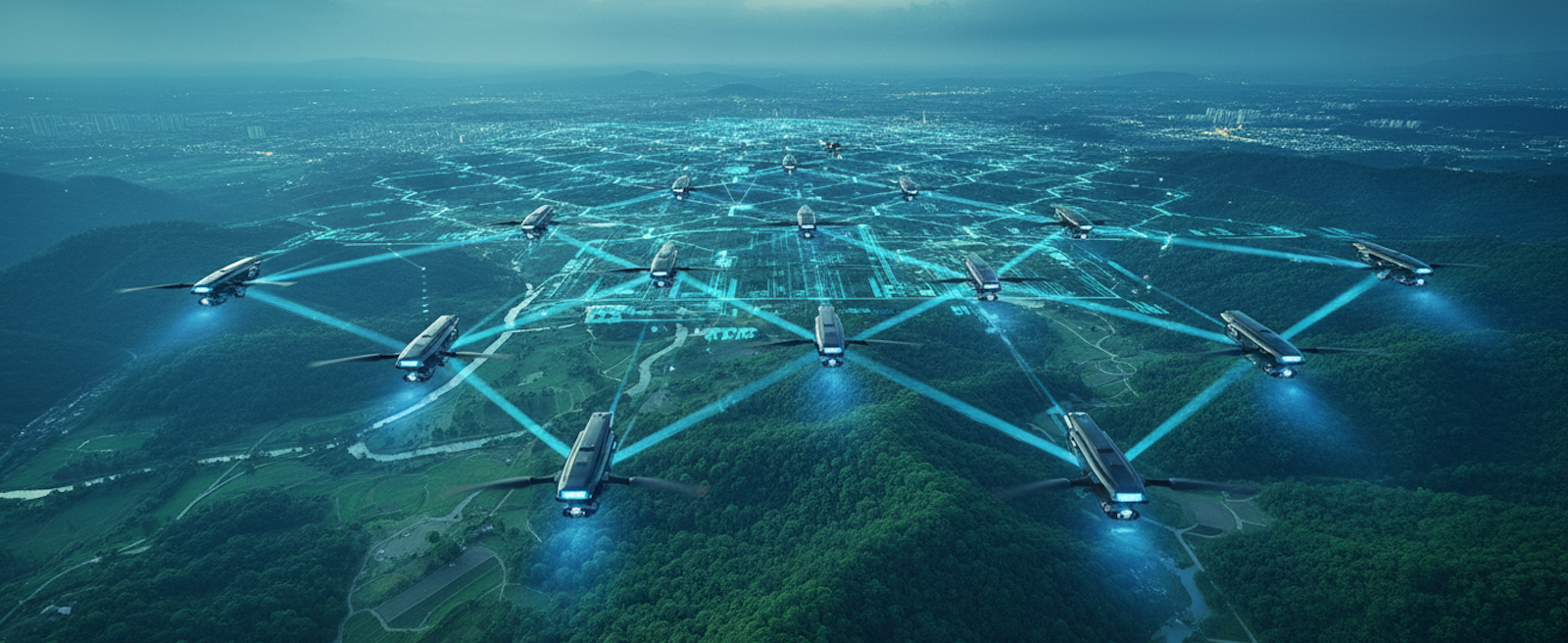
The idea of a drone swarm—a group of robots working together like a colony of insects—has long been a staple of science fiction. But today, this technology is rapidly moving from fiction to reality. These swarms aren’t just about flying in formation; they represent a paradigm shift in robotics, moving from single, centrally-controlled units to decentralized, intelligent, and resilient multi-agent systems—a cornerstone of modern AI in robotics.
In this article, I’ll walk you through the architectural blueprint for creating a truly autonomous swarm. We’ll explore the core principles, the essential software modules, and the dynamic logic that allows a group of drones to collaboratively solve complex problems. The concepts here are based on a real-world implementation I’ve been developing. To make the technology more relatable, I’ll frame it around a simplified business case: an autonomous swarm designed to protect apiaries by finding and neutralizing invasive wasp nests.
While the specific code for this project remains in a private repository, the architectural patterns and lessons learned are universal. Whether your goal is precision agriculture, infrastructure inspection, or search and rescue, these principles will provide a robust foundation for your own multi-robot systems.
The Core Philosophy: Decentralization is King
The first and most critical decision in autonomous swarm design is choosing between a centralized and a decentralized architecture.
Swarm Architecture
Centralized Control
Decentralized Hive Mind
A centralized system relies on a single “leader” drone or a ground control station (GCS) to make all decisions. It receives data from all drones, processes it, and sends specific commands back to each one. This is simple to conceptualize but creates a catastrophic single point of failure. If you lose the leader or the communication link to the GCS, the entire swarm becomes useless.
A decentralized architecture, which we’ve implemented, is fundamentally different. Each drone is a fully independent agent. It runs its own “brain,” makes its own decisions, and communicates with its peers on a level playing field.
This approach delivers three huge advantages for swarm robotics:
- Resilience: The loss of one or even several drones does not stop the mission. The remaining drones can recognize the loss, communicate, and re-distribute the workload to ensure the objective is still met.
- Scalability: Adding more drones to the swarm doesn’t require a more powerful central computer. You simply add another agent to the network, and the swarm’s collective capability grows linearly.
- Robustness in Hostile Environments: The swarm can operate even with intermittent communication or in GPS-denied environments. This is not an accident; it’s a core design feature.
The Anatomy of a AI Swarm Agent
At the heart of our decentralized system is the Swarm Agent. This is the main software stack running on each drone’s companion computer (like a Jetson Orin Nano). It’s the drone’s brain, and it’s built from several key modules, all orchestrated by a state machine.
A state machine is the agent’s central nervous system and a fundamental concept in control systems for AI in robotics. It defines every possible state a drone can be in—from IDLE on the ground to SEARCHING_SECTOR, ATTACKING, or RETURNING_TO_BASE. The drone can only be in one state at a time, which makes its behavior predictable, manageable, and far easier to debug. The agent’s entire life cycle is a transition through these states based on sensor data, peer communication, and mission progress.
Anatomy of a Swarm Agent
(Orchestrator)
Let’s break down the modules that the state machine manages.
1. The Mission Planner: Defining the Sandbox
Before a mission starts, the swarm needs to know its operational boundaries. The Mission Planner is not a dynamic, in-flight module, but rather a foundational component that sets up the “rules of the game.”
- Function: Its primary job is to take a high-level mission definition—typically a set of GPS coordinates forming a fence around the territory—and divide it into smaller, manageable sectors.
- Territory Division: The simplest and most effective way to do this is to divide the area into equal “strips,” like lanes in a swimming pool. Each drone is initially assigned a sector based on its unique ID (e.g., Drone 0 gets Sector 0, Drone 1 gets Sector 1, and so on).
- Search Pattern Generation: Once a drone knows its sector, the Mission Planner generates a methodical search path, like a lawnmower pattern, to ensure the drone covers every square meter of its assigned area.
2. The Swarm Communicator: The Jamming-Resistant Social Network
This module is the lifeblood of the autonomous swarm. It allows drones to share information and coordinate their actions, even under adverse conditions.
- Technology: We use a reliable, TCP-based mesh network. Each drone attempts to establish and maintain a direct connection with every other drone in the swarm. TCP guarantees that messages are received correctly and in order.
- Resilience to Wi-Fi Jamming: The communicator is designed to be interruption-resistant. If a drone’s Wi-Fi signal is jammed, it doesn’t just give up. The software is designed to automatically hop between different Wi-Fi frequencies and channels to find a clear line of communication.
- Message-Based Protocol: Drones communicate using a structured, event-driven protocol with key message types like
SWARM_HEARTBEAT,HIVE_ANNOUNCEMENT,SECTOR_STATUS_UPDATE, andSECTOR_CLAIM.
3. The Vision Module & Position Estimator: AI-Powered Perception
This is the perception system—the “eyes” of the drone and the core of its intelligence. For high-stakes applications in robotics, precision is non-negotiable.
- Vision Module with Stereo Vision: Each drone is equipped with a high-end stereo camera, like a ZED X. By having two lenses, it directly calculates a dense, real-time depth map of its surroundings, providing a direct, high-fidelity measurement of the distance to every pixel in its field of view.
- Position Estimator: This is where we turn that precise vision data into actionable intelligence. The estimator algorithm takes the 2D pixel coordinates from the YOLO model, the precise depth from the stereo camera, and the drone’s own position and attitude to calculate the target’s absolute 3D coordinates with centimeter-level accuracy. This gives the autonomous swarm an actionable location that any drone can navigate to.
4. The Attack Controller: The Specialized Muscles
This module is the bridge between the agent’s high-level decisions and the drone’s flight controller. It’s where the swarm’s physical actions are defined and executed. A key feature of our architecture is its ability to manage a heterogeneous swarm, where different drones have different capabilities.
In our example, the swarm consists of two types of drones:
- “Rammer” Drones: These are lightweight, high-speed FPV-style drones with one side heavily armored.
- “Bomber” Drones: These are heavier drones equipped with a servo-actuated payload mechanism to drop a heavy object.
Heterogeneous Swarm Capabilities
The Attack Controller is designed to be “type-aware.” When initialized, it knows which type of drone it’s running on and loads the appropriate logic.
- For Rammer Drones: The controller’s primary function is the
execute_attack_maneuver. This is a closed-loop, high-speed ramming run. - For Bomber Drones: The controller uses a completely different function:
execute_bombing_run. This maneuver involves flying directly above the target and releasing a payload.
This specialization is handled elegantly within the Swarm Agent. When a drone detects a target, it announces it to the swarm. The agent’s logic dictates that the detecting drone is the one to perform the attack. It simply calls its own Attack Controller, which automatically executes the correct maneuver based on its pre-configured type.
Resilience to GPS Jamming: The swarm is not dependent on GPS. If the signal is lost, the drones seamlessly switch to Visual-Inertial Odometry (VIO). Using their stereo cameras and on-board Inertial Measurement Units (IMUs), they can accurately track their motion relative to the visual features of the environment. This is a critical capability in AI in robotics, enabling true autonomy even indoors or in jammed areas.
Emergent Intelligence: Handling Failure and Re-Tasking
The true power of a decentralized autonomous swarm is revealed when things go wrong. What happens when a drone is lost due to a malfunction or damage?
How the Swarm Heals Itself (Emergent Intelligence)
Normal Operation
Failure Detected
Task Re-Allocation
Conflict-Free Claim
- Detecting the Loss: Every drone acts as a watchdog, listening for heartbeats from its peers. If a drone goes silent, it is marked as “lost.”
- Emergent Leadership: To prevent chaos, a leader emerges dynamically. In our system, the active drone with the lowest ID is automatically considered the leader. This is a simple, deterministic rule that requires no election or negotiation.
- The Leader’s Duty: Only the current leader has the authority to officially declare the lost drone’s sector as “abandoned” by broadcasting a
SECTOR_STATUS_UPDATEto the swarm. - The Claiming Process: Drones that have already completed their own sectors enter an
EVALUATING_MISSIONstate. They see the newly abandoned sector, calculate their distance to it, and the closest drone broadcasts aSECTOR_CLAIMmessage. - Conflict-Free Resolution: What if two drones claim the same sector? This is solved with another simple, deterministic rule. If a drone hears a claim for the same sector from a drone with a lower ID, it immediately backs down. The lowest ID always wins.
The winning drone then reconfigures its Mission Planner for the new sector, transitions to the TRANSITING_TO_SECTOR state, and the mission seamlessly continues. This entire process is a beautiful example of emergent behavior. There is no central commander; the intelligence and resilience are properties of the swarm itself, a key goal in advanced AI in robotics.
Final Thoughts
Building an autonomous swarm is a formidable challenge, but by adopting a decentralized, agent-based architecture, the problem becomes manageable. By breaking the system down into discrete, robust modules—a state machine, a mission planner, a jamming-resistant communicator, a stereo-vision perception system, and a type-aware controller—you can create a foundation that is scalable, resilient, and adaptable to any number of applications, pushing the boundaries of modern robotics.
The real beauty of this approach is not just in the individual components, but in how they enable complex, intelligent behavior to emerge from simple rules. The swarm’s ability to heal itself by reallocating tasks after losing a member is not programmed as a top-down directive; it’s a natural outcome of the system’s design.
The work described here is part of an ongoing research and development project, and the source code is currently held in a private repository. However, if you are working on similar challenges in autonomous systems and AI in robotics, and would like to discuss architecture or potential collaborations, please feel free to reach out.
Frequently Asked Questions
What is an autonomous swarm in robotics?
An autonomous swarm is a group of robots that work together collaboratively to achieve a common goal without direct human control. Inspired by insect colonies, each robot in the swarm is an independent agent that can sense its environment, communicate with its peers, and make its own decisions. This decentralized approach is a key area of advancement in AI in robotics.
Why is a decentralized architecture better for a drone swarm?
A decentralized architecture makes an autonomous swarm incredibly resilient and scalable. Unlike a centralized system that relies on a single leader, there is no single point of failure. If one or more drones are lost, the rest of the swarm can adapt and continue the mission. It also allows for easy scaling—you can simply add more drones to the network to increase the swarm’s capability.
How does the swarm work without GPS?
This architecture is designed for GPS-denied environments. If GPS is lost, the drones seamlessly switch to Visual-Inertial Odometry (VIO). By combining data from their stereo cameras (visual) and on-board IMUs (inertial), they can accurately track their movement relative to the environment, allowing them to navigate and complete tasks with high precision.
What is “emergent intelligence” in swarm robotics?
Emergent intelligence is when complex, seemingly intelligent group behaviors arise from simple rules followed by individual agents. In this system, for example, there is no central commander that re-assigns tasks when a drone fails. Instead, the behavior “emerges” from rules like “the active drone with the lowest ID becomes the leader” and “the closest available drone claims an abandoned task.”