Key Takeaways
- HNSW is the RAG Standard: The Hierarchical Navigable Small World algorithm offers the best balance of speed and accuracy, making it the default engine for low-latency RAG applications in Pinecone and Weaviate.
- DiskANN Enable Massive Scale: For enterprise RAG requiring billion-scale datasets, Milvus uses DiskANN to leverage NVMe SSDs, significantly reducing RAM costs without sacrificing performance.
- Filtering is Critical for Agentic AI: Agentic AI requires precise context retrieval. Qdrant’s filterable HNSW with Binary Quantization ensures that complex metadata filters do not break the search graph, enabling agents to find specific memories reliably.
- Hybrid Search Boosts Relevance: Weaviate and Azure AI Search utilize Hybrid Search (Keywords + Vectors), which is essential for correcting the semantic “hallucinations” often seen in pure vector-based RAG pipelines.
- ScaNN for High Throughput: Google Vertex AI’s unique ScaNN algorithm utilizes tree-quantization to deliver the highest queries-per-second (QPS), ideal for high-traffic recommendation agents rather than simple chat bots.
Vector databases have evolved from niche recommendation engines to the long-term memory for Agentic AI and the backbone of modern RAG (Retrieval-Augmented Generation) pipelines. But for the architect building these systems, the choice of database is not just about API convenience; it is about the underlying algorithm.
While the surface APIs (like query_vector) look similar, the underlying algorithms dictate the latency of your RAG response, the recall accuracy of your agent’s memory, and the cost of scaling to billions of vectors.
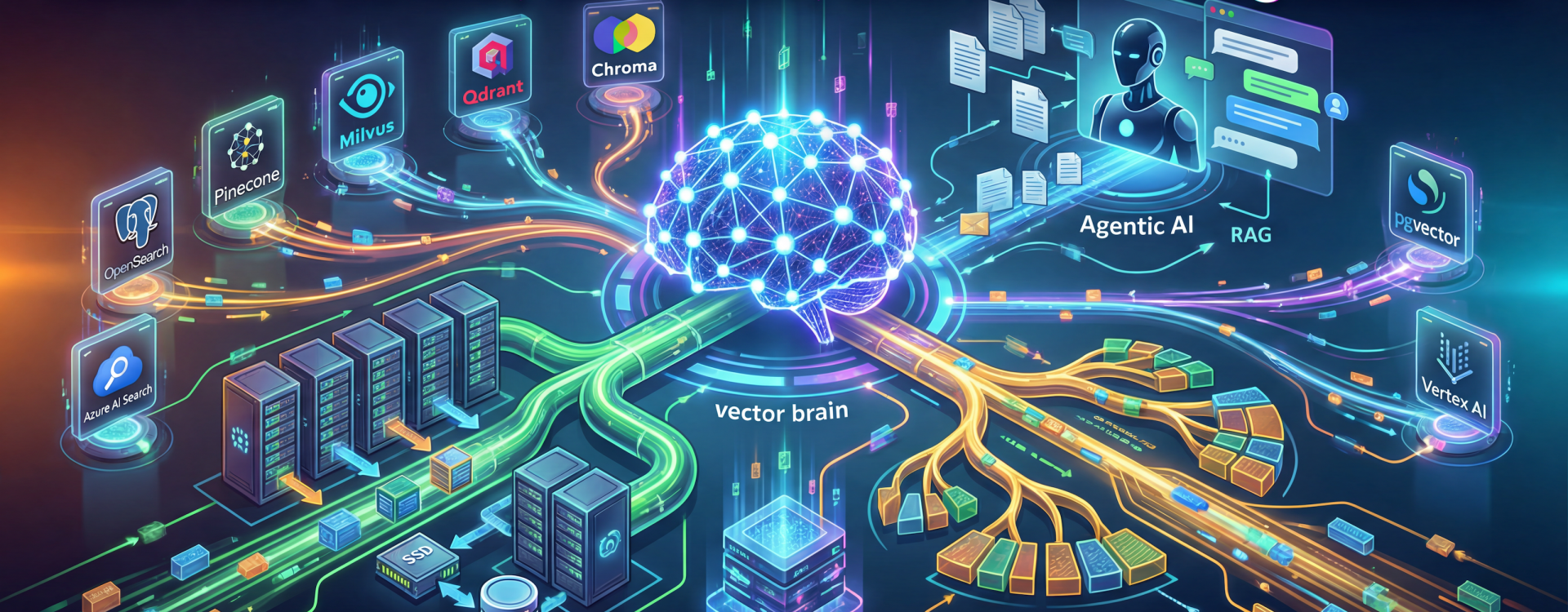
This article dissects the algorithmic engines powering Pinecone, Milvus, Qdrant, Weaviate, Chroma, MongoDB Atlas, OpenSearch, pgvector, Azure AI Search, and Google Vertex AI Vector Search.
Part 1: The Core Algorithms Explained
Before analyzing specific databases, we must understand the three primary algorithmic families that power RAG and Agentic AI.
1. HNSW (Hierarchical Navigable Small World)
- Mechanism: A graph-based algorithm that builds a multi-layer structure. The top layers are sparse “highways” allowing long jumps across the vector space, while lower layers are dense “neighborhoods” for fine-grained search.
- Relevance to RAG: HNSW offers the best-in-class trade-off between query speed and recall. For real-time RAG applications (like customer support bots) where every millisecond counts, HNSW is the preferred choice.
- Cons: Memory-hungry. The entire graph topology typically needs to reside in RAM, which can drive up infrastructure costs for large memory banks.
2. IVF (Inverted File Index) & Quantization (PQ/SQ)
- Mechanism:
- IVF: Clusters the vector space into Voronoi cells. During search, it only scans the closest few clusters.
- Quantization (SQ/PQ): Compresses vectors. Scalar Quantization (SQ) reduces 32-bit floats to 8-bit integers.
- Relevance to Agentic AI: While slightly slower than HNSW, IVF coupled with quantization allows for massive data compression. This is crucial for autonomous agents that need to retain vast amounts of historical logs or “episodic memory” without breaking the bank.
3. DiskANN (Vamana Graph)
- Mechanism: A graph algorithm designed specifically for NVMe SSDs. It builds a graph (Vamana) that minimizes “disk hops,” allowing the index to live on disk rather than RAM.
- Relevance to RAG: DiskANN is a game-changer for enterprise RAG. It decouples index size from RAM capacity, allowing you to search billion-scale proprietary datasets at a fraction of the cost of in-memory solutions.
Part 2: Vector Store Specifics
1. Pinecone
- Algorithm: Proprietary HNSW variant (Pod-based) & Bifurcated Storage/Compute (Serverless).
- Deep Dive:
- Pod-Based: Uses a highly tuned HNSW graph held in memory.
- Serverless: Separates storage (Blob/S3) from compute. It likely uses Scalar Quantization aggressively to keep “hot” vectors in cache while spilling “cold” data to object storage.
- Best For Agentic AI: The serverless architecture is ideal for Agentic AI swarms where usage is bursty. You don’t need to provision shards manually; the system scales up as your agents generate more memories and scales down when they are idle.
2. Milvus
- Algorithms: HNSW, IVF_FLAT, IVF_PQ, DiskANN.
- Deep Dive: Milvus is an algorithmic Swiss Army Knife.
- DiskANN: One of the few commercially available implementations of the Vamana graph. This enables large-scale RAG on limited RAM by leveraging NVMe SSDs.
- Partition Key: Allows physical separation of data. This ensures that an AI Agent acting for a specific tenant only searches that tenant’s data, drastically improving security and speed.
- Best For: Billion-scale datasets (using DiskANN) or high-throughput RAG scenarios requiring fine-grained control over index parameters.
3. Qdrant
- Algorithm: HNSW (Modified with Custom Quantization).
- Deep Dive: Qdrant solves a specific problem in Agentic AI: filtering. Standard HNSW struggles when you apply metadata filters (e.g., “Find memories from yesterday”). Qdrant maintains connections even when nodes are hidden by filters, preventing the “disconnected graph” problem.
- Binary Quantization (BQ): Compresses vectors to 1-bit per dimension. Used with Rescoring (oversample candidates using BQ, then refine with full float32 vectors).
- Best For: Complex Agentic AI workflows requiring heavy metadata filtering (e.g., “Retrieve tool usage instructions, but only for Python tools, created last week”).
4. Weaviate
- Algorithms: HNSW, Flat, Dynamic.
- Deep Dive:
- Dynamic Index: Automatically promotes a “Flat” index to an HNSW graph as data grows.
- Hybrid Search: Weaviate treats vector search and keyword search as equal citizens.
- Best For: Hybrid RAG. Pure vector search often fails on specific jargon or SKUs. Weaviate’s ability to combine HNSW vector results with BM25 keyword results ensures the Generative AI model gets the most accurate context possible.
5. Chroma
- Algorithm: HNSW (hnswlib/custom).
- Deep Dive: Chroma is designed to be “AI-native.” In “local” mode, it utilizes SQLite and simple in-memory HNSW. It focuses on the developer loop rather than complex parameter tuning.
- Best For: Python-centric prototyping and Local Agentic AI. If you are building an agent that runs locally on a user’s machine (using smaller LLMs), Chroma’s lightweight HNSW implementation is perfect.
Part 3: The “Integrated” Vector Stores
These platforms add vector search to existing engines, simplifying the RAG architecture by removing the need for a separate database.
6. MongoDB Atlas Vector Search
- Algorithm: HNSW (via Lucene).
- Deep Dive: Leverages the Apache Lucene library integrated into the MongoDB cluster.
- Best For: Applications already using MongoDB. It unifies operational data (JSON) and vectors, simplifying the data pipeline for RAG applications that need to retrieve both unstructured text and structured user data in one go.
7. PostgreSQL (pgvector)
- Algorithms: IVFFlat and HNSW.
- Deep Dive:
- HNSW: Fully featured in Postgres, allowing for UPDATE/DELETE operations—a rarity in vector search that is crucial for maintaining up-to-date RAG knowledge bases.
- Best For: Keeping the stack simple. If your Agentic AI needs ACID compliance and transactional integrity alongside semantic search, pgvector is the logical choice.
8. OpenSearch & Amazon OpenSearch Service
- Algorithms: HNSW, IVF (Faiss & NMSLIB engines).
- Deep Dive: OpenSearch allows you to swap the underlying “engine” (NMSLIB or FAISS).
- Best For: Log analytics and keyword-heavy search that needs “some” semantic capabilities added to an existing RAG pipeline.
9. Azure AI Search
- Algorithm: HNSW & Exhaustive KNN.
- Deep Dive: Heavily optimized for Hybrid Search with Reciprocal Rank Fusion (RRF). It creates a unified score from vector and keyword results.
- Best For: Enterprise RAG on Azure. The Semantic Reranker included in Azure AI Search is widely considered one of the best for improving the relevance of context fed to models like GPT-4.
10. Google Vertex AI Vector Search
- Algorithm: ScaNN (Scalable Nearest Neighbors).
- Deep Dive: Unlike HNSW, ScaNN uses a Tree-Quantization hybrid. It partitions the space and uses anisotropic vector quantization to score.
- Best For: High-Throughput Agents. ScaNN consistently beats HNSW in QPS (Queries Per Second) benchmarks. It is best for recommendation agents that need to serve millions of users concurrently with high recall.
Summary & Recommendation Matrix
| Database | Algorithm Core | Best Feature | When to Use |
|---|---|---|---|
| Pinecone | Proprietary HNSW | Serverless / Ease of Use | You want managed RAG infrastructure with zero maintenance. |
| Milvus | HNSW / DiskANN | Disk-based Indexing | You have massive datasets and need cost-effective RAG storage. |
| Qdrant | HNSW + BQ | Filterable HNSW | Your Agentic AI requires complex context filtering and memory efficiency. |
| Weaviate | HNSW / Dynamic | Hybrid Search | You need the highest accuracy Hybrid RAG (Keyword + Vector). |
| Chroma | HNSW | Developer Experience | You are building local Python Agents or prototypes. |
| pgvector | HNSW / IVFFlat | ACID Compliance | You want to integrate RAG into an existing Postgres stack. |
| Vertex AI | ScaNN | Throughput (QPS) | You are building massive-scale recommendation agents. |
| Azure AI | HNSW + RRF | Hybrid Relevance | You prioritize answer quality in Enterprise RAG applications. |
Frequently Asked Questions
Which vector algorithm is best for RAG applications?
For most real-time RAG (Retrieval-Augmented Generation) applications, HNSW is the gold standard. It provides sub-millisecond latency and high recall, ensuring LLMs receive context instantly. However, for massive datasets where cost is a factor, DiskANN (used by Milvus) is superior as it offloads storage to SSDs.
How does vector search enable Agentic AI?
Agentic AI relies on long-term memory to function autonomously. Vector databases act as this memory. Algorithms that support efficient metadata filtering (like Qdrant’s implementation) allowing agents to “remember” specific facts based on time, location, or context, rather than just generic semantic similarity.
What is the difference between HNSW and IVF?
HNSW (Graph-based) and IVF (Cluster-based) are the two main families of search algorithms. HNSW is faster and more accurate but consumes more RAM, making it ideal for high-performance RAG. IVF is more memory-efficient but requires a “training” step and generally offers lower recall, which can affect the quality of AI responses.
Why is Hybrid Search important for GenAI?
Pure vector search sometimes misses exact keyword matches (like specific product IDs or names). Hybrid Search combines vector semantic retrieval with BM25 keyword matching. This ensures RAG systems retrieve the correct documents, reducing hallucinations in critical enterprise applications.